The following photo list of greens is a work in progress. I will start with the spring/early summer greens (makes sense, seeing as it is early summer) and add later season greens as they come ready for harvest.
I hope the pictures are attractive, but I've tried to resist the urge to select only the most perfect samples of each green to photograph. That's because the greens we harvest are never entirely perfect. They grew in a field outside, exposed to sun, rain, wind, and insects. They lived good lives and it shows.
I'm going to keep the list alphabetical, rather than seasonal because some greens span the entire growing season.
Hopefully this will help members answer questions such as: "Which one's mizuna again?" and "What was that weird spicy lettuce in my share last week?"
 |
| Arugula |
Arugula harvest starts in the spring, takes a break in the hot summer (assuming the summer actually gets hot) and resumes in the fall. The flavor of arugula is the most complex of all the greens we grow. It tastes, sweet, spicy, nutty, bitter, and musky (for lack of a better term) all at once. Arugula tastes slightly different with each cutting. We never know which flavor will shine the brightest, but it always tastes distinctively arugula-y. It is a wonderful salad green, though some people find its raw flavor an acquired taste. If you aren't into it raw, try it cooked (arugula quiche is very good) or tuck a few leaves into a sandwich and sort
of ease into it.
 |
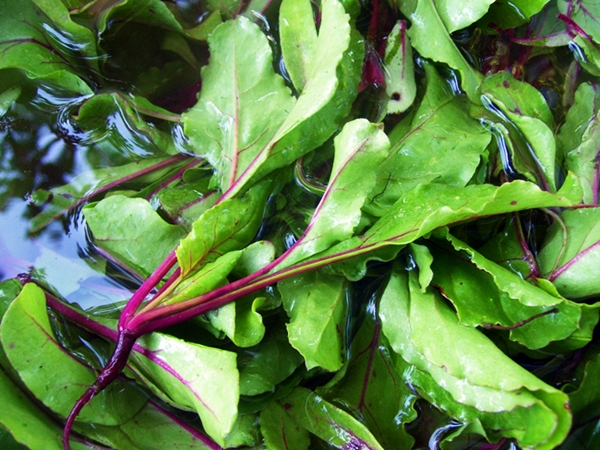
| Beet Thinnings |
These greens are the tops of immature beets. Beet seeds are unusual because each seed is actually a cluster of fruits that produces more than one plant. This means that no matter how thinly you plant your beets you are going to have to thin out some seedlings if you want the roots to be able to mature. The results of thinning all of those beets is a brimming bucket of tender beet greens. They are yummy as both a salad or cooked green, with the same earthy, slightly salty, flavor as chard (which is the same species as the beet). We like to include them in our braising mix.
 |
| Braising Mix |
This blend of cooking greens varies depending on what is available at harvest time, and its flavor will vary accordingly. Recognize it as braising mix, rather than a salad blend, by the large, relatively tough, strong flavored leaves it contains. It might include any or all of the following greens: kale, chard, beet greens, mizuna, mustard, arugula, dandelion, purple orach, senposai, turnip greens, and probably some others I haven't thought of. It can be used in any recipe calling for cooked greens. If you are not sure what to do with it, try this: Heat 1 Tbs olive oil in a large frying pan with a generous pinch of salt and some fresh ground pepper, chop your greens roughly, stir the greens into the olive oil until they wilt, add half a cup water and 1 tsp balsamic vinegar, cover and simmer for about twenty minutes. Do that, and your greens are braised. You can eat it as is, cook it in a quiche, serve it over rice, or mound it on top of a grilled t-bone.
 |
| Chard |
We grow rainbow chard. When full sized the leaves are large like kale. The baby leaf in the picture is from a batch of braising mix. Recognize chard by the shiny leaf, brightly colored stems, and earthy beet like flavor. Chard is actually the same plant as the beet, just bred for leaf rather than root growth. It is best cooked. It can be braised, sauteed, seared, or cooked however you see fit. In the fall we love to add strips of chard to creamy squash soup right at the end of cooking. Also, please don't discard your stems! Many recipes call for discarding the stems of chard but we find that chopping them up small and cooking them for a few minutes before adding the leaves adds color, crunch, and all around goodness to the finished dish.
 |
| Dandelion |
This intensely bitter green looks exactly like the dandelion leaves that are growing in your yard, except that it has a dark red mid-rib. That being said, cultivated dandelion greens are not actually dandelion at all. This dandelion is a chicory. The one we grow is called Italiko Rosso Chicory, which I have to admit does sound much more gourmet than dandelion. This year we grew only a small patch of dandelion, for adding to our braising mix. We like its bitter bite and tender texture. For now, cook it up with the rest of the braising mix. Next year we might grow enough to include it as a salad green as well.
 |
| Kale |
Sorry, I couldn't resist a bit of fanciness with the kale photo. One of the most striking things about kale is the silver cast it takes on under water. That's what you see in this picture. Kale harvest starts early and continues through the entire CSA season, though we don't necessarily harvest it every week. We grow a few different varieties of kale, some with purple stems, some with ruffled leaf margins. Though it might look different from week to week, kale is always recognizable as a large dark grey green relatively tough leaf. The flavor is of a slightly sweet and spicy (clove spice, not jalapeno spice) cabbage. It is best cooked, we like to chop it up and toss it into all sorts of dishes (spaghetti sauce, scrambled eggs, soup...) towards the end of cooking.
 |
| Head Lettuce |
Lettuce prefers cool weather so it is generally an early and late season green. We are experimenting with several different varieties of head lettuce this year, along with our favorite leaf lettuces, to try to provide members with as many weeks of lettuce as possible. The one in this photo is called Tom Thumb, because of its small size. I imagine most of you will have no trouble recognizing the lettuce in your share, just keep in mind that it might look a little different from week to week.
 |
| Leaf Lettuce |
This combination of two varieties of leaf lettuce (tango - the green, and merlot - the red) is our go to lettuce. It grows well for us, isn't unpredictable like head lettuce can be, stands up to all but the driest heat, and the deer don't covet it the way they do the head lettuce. You will see it more than once throughout the CSA season. Happy salad!
 |
| Mizuna |
Mizuna grows quickly and holds well in the field all season long. When we cut it, it grows back for us. It is a mild green that is equally good cooked or raw. All of these things mean it is a CSA staple. Growers love it, but members have trouble remembering what it is called and figuring out what to do the it. If you are at a loss here is my suggestion: Chop the mizuna up small (half inch or so), boil some pasta in well salted water, heat a generous portion of good olive oil in a frying pan, add some minced garlic to the olive oil and stir till it's golden, coat the pasta with the garlic/oil then stir in the mizuna. Now that you have enjoyed your first mizuna meal, experiment from there. Remember, it's the spiky green.
 |
| Mustard |
Many of the greens we grow are mustards of one sort or another, but this one is the standard. Mustard grows quickly in the early season, then keeps on growing quickly until it flowers and its leaves become inedibly tough. We include it in our shares as long as it is tasty. Sweet, spicy (this time I mean like jalapenos) and delicate, mustard is good in salad and delicious cooked but it does cook down
a lot. It is heavenly atop a grilled burger.
 |
| Purple Orach |
It feels a little silly to call this intensely purple leaf a green, but I guess it would be even worse to call it a purple. Its flavor is slightly astringent, like strong spinach. It is, in fact, a relative of spinach that's often grown as a late season spinach "replacement" by gardeners who wish it was spinach season all year long (don't we all...). We're experimenting with orach this year, and only have a small trial patch so expect to see it in mixes such as the braising mix. It's tender enough to use as a salad green but, so far, we like its flavor best cooked. Please let us know how you like it.
 |
| Baby Pac Choi |
Pac choi (or bok choy) is probably the most familiar of the Asian greens we grow. We favor a baby variety called shuko, which is quite a bit smaller than most varieties of pac choi. It makes a delicious stir fry and is tender enough to enjoy raw. If you're not sure which one is the pac choi, look for paddle shaped leaves that are mostly fleshy stems. If its new to you, remember, this green is really all about the stems so don't discard any part of it.
 |
| Radicchio |
Radicchio is impressively bitter. Its bitterness by far out bites the other bitter greens we grow. You may, then, wonder I would suggest that you add it to a salad. It's a matter of balance. A big bowl of plain radicchio is not all that appetizing, even to those of us who appreciate bitter. A simple salad of radicchio with a pinch of sea salt, a drizzling of good balsamic vinegar, and maybe some freshly grated pepper and Parmesan cheese is, on the other hand, appetizing to pretty much everyone who eats salad. It goes well in any salad that includes powerful flavors, such as blue cheese, berries, or sorrel. Radicchio is also often braised (see the braising mix above for the technique). Braised radicchio combined with garlic and Parmesan cheese is wonderful served over pasta.
 |
| Senposai |
Senposai is also an Asian mustard green. The varieties are truly endless. This one is mild and sturdy, but still tender. To me it is a cross between kale and pac choi. The leaves are large and look somewhat like kale, but they are tender like pac choi and don't have kale's strong cabbage flavor. This is the first year we have grown this particular green and so far we have included it in the braising mix - it is fantastic cooked - but it will likely show up as a bunched green as well later in the season. Use it in a stir fry or a salad. It will serve you well cooked or raw.
 |
| Sorrel |
This is probably the most uncommon green we grow, which is surprising because it is by far the easiest. We planted a patch years ago and have been harvesting it ever since. It starts growing in the spring, almost as soon as the snow melts, and, as long as we keep picking it, produces all summer long. Sorrel is bright green, sometimes with a touch of hot pink, and brightly flavored. It is tart. Kids tend to gobble it up raw but I prefer to temper its flavor by cooking it. Sauteed in a bit of olive oil, it sort of melts into a thick sauce which is the world's most perfect omelet filling, especially when paired with goat cheese.
 |
| Spinach |
Spinach, like lettuce, probably needs no explanation. It is an early green that simply does not grow well once summer has gotten underway. We celebrate its brief appearance in the beginning of the season with a much appreciated salad, then await its return the following year.